
Online Dog Training vs In-Person Trainer: Which One Actually Works?
Online Dog Training vs In-Person Trainer: Which One Actually Works?
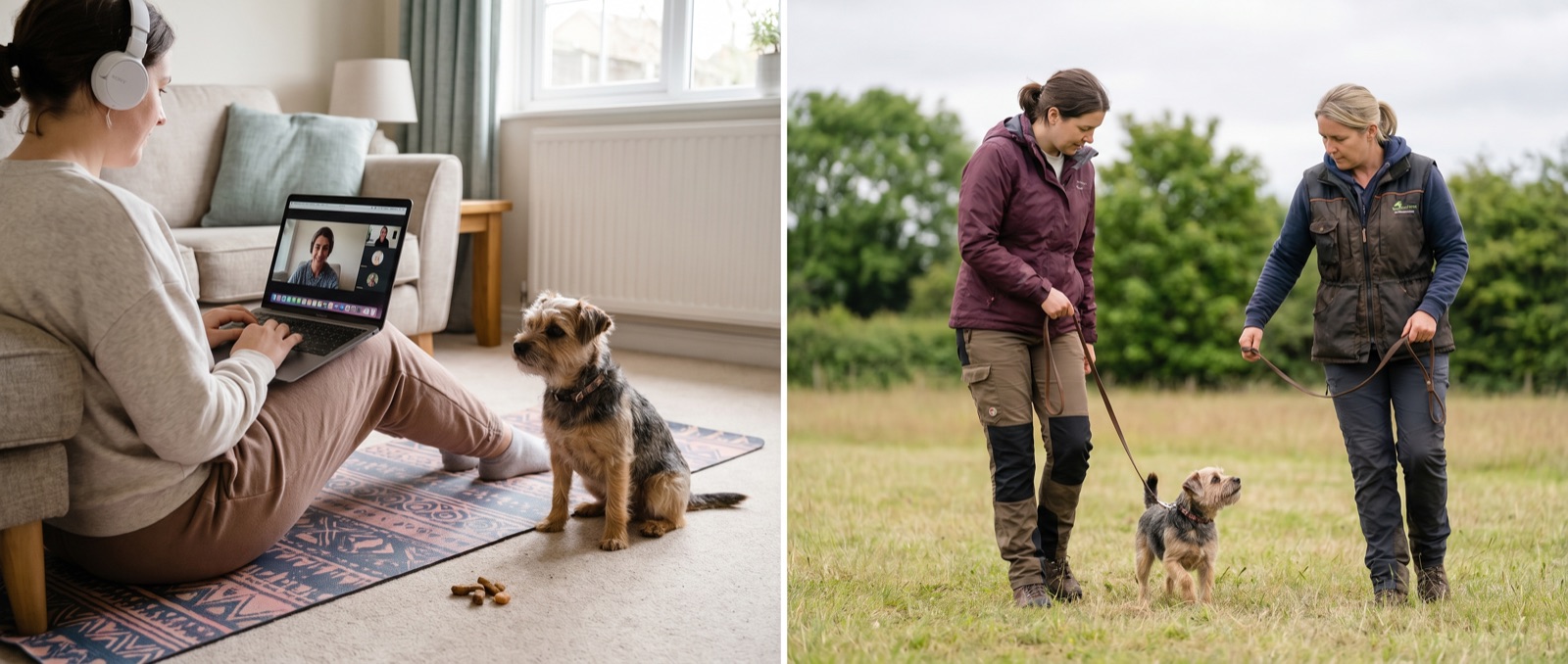
In 2026 you have more dog-training options than ever — from $0 YouTube channels to $300/hr private behaviorists, with apps, AI coaches, group classes, and Zoom-based virtual training in between.
People assume in-person is "the gold standard" and online is "the cheap version." That's not always true. The right format depends on your dog, your goal, and your budget.
Here's the honest comparison.
The four formats, fairly compared
| Format | Typical cost (US) | Best for | Honest weakness | |---|---|---|---| | YouTube / books | Free–$30 | Self-motivated owners learning theory | No personalization, no curriculum, no feedback | | Group obedience class | $150–$300 / 6 weeks | Basic obedience, socialization for sociable dogs | Not appropriate for reactive dogs; pace fixed by class | | Online / virtual training (Zoom) | $50–$150 / session | Convenience, post-class follow-ups | Trainer can't fully see body language or environment | | AI-personalized plans + AI trainer (e.g., AutoDoggy) | $11–$20 one-time + optional sub | Full personalization, on-demand follow-ups | Cannot physically observe your dog | | Private in-person trainer | $80–$200 / hr | Severe behavior, complex cases | Expensive, scheduling-limited | | Veterinary behaviorist | $300–$600 / consult | Aggression, complex anxiety, medication needs | Long waitlists, high cost |
When in-person is genuinely better
You should use in-person training when:
- Your dog has bitten a person (Level 3 bite or higher on Dunbar's scale).
- You're seeing aggression toward family members.
- Your dog has severe separation anxiety with self-injury.
- You're training a service dog or sport dog at competition level.
- You've been working consistently for 6+ weeks with no progress on a behavior, and you suspect your timing or body language is the issue.
Bottom line: when the dog is dangerous, when the stakes are high, or when you genuinely can't see what you're doing wrong — pay for hands.
When online or AI-based training is genuinely better
Use online or AI-based training when:
- You're working on standard obedience and manners.
- You have a puppy and you need a daily plan, not a weekly class.
- You travel, work shifts, or have a schedule that doesn't match a class calendar.
- You've had a class before and need a structured plan to keep practicing.
- You can't access a qualified positive-reinforcement trainer in your area.
- You want to spend your money on dog stuff (training tools, real food, vet care) instead of a 6-week class that is 90% review.
Why a daily plan beats a weekly class
The single biggest factor in dog training is frequency. A dog trained 5 minutes a day, every day, will outperform a dog trained 60 minutes once a week.
Group classes are once a week. Most private trainers are once a week. You are with your dog every day. The format that gives you the best daily plan — not the most credentialed weekly conversation — usually wins.
This is the structural argument for AI-personalized plans. Not "AI is smarter than a human trainer" (it isn't, in many ways). It's "AI can give you the right exercise to do tonight, every night, written for your dog." That's hard for a once-a-week class to match.
What to ask any trainer (online, in-person, or AI)
Before committing money:
- What methods do you use? "Balanced" is a polite word for "I use punishment when I feel like it." Look for "force-free," "positive-reinforcement-based," or "LIMA" (Least Intrusive, Minimally Aversive).
- What credentials do you have? Certifications worth looking for: CPDT-KA, KPA-CTP, IAABC, CSAT (for separation anxiety), ACAAB or DACVB (for behaviorists). "Cesar Millan-style" is not a credential.
- How do you handle setbacks? A trainer who blames the dog ("dominant," "stubborn") instead of adjusting their method is not the right trainer.
- Can I see your training plan? A real plan should sequence behaviors over weeks. "We'll see how it goes" is not a plan.
For AI tools (including ours), ask the same questions. The methods should be force-free. The plan should sequence behaviors over weeks. There should be a way to ask follow-up questions.
A practical recommendation
For most pet owners with a typical dog, the highest-leverage stack is:
- An AI-personalized plan + AI trainer for the daily structure and constant troubleshooting. This is what we built AutoDoggy to be.
- One in-person session every 1–2 months with a positive-reinforcement trainer to catch your timing/body-language errors and validate progress.
- A behavior consult if anything seems off — better to pay $300 once than to make $500 of mistakes.
That stack gets you better results than any single format alone, for less than the cost of a weekly class.
Curious what an AutoDoggy plan would look like for your dog? Build it in 5 minutes →